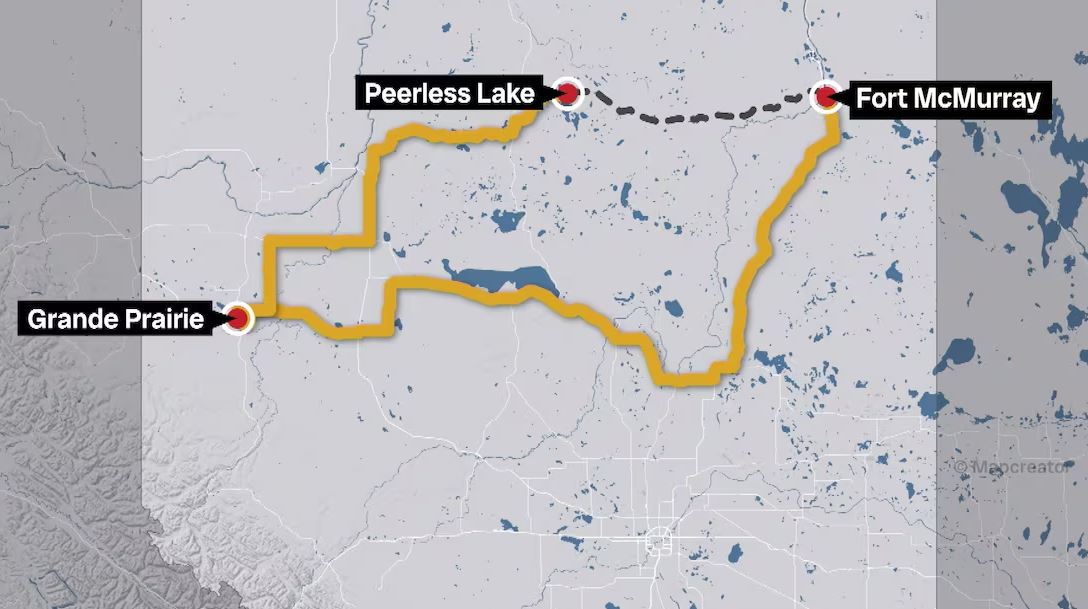
The Alberta Government is moving forward with an extensive plan to extend Highway 686, creating a new major roadway in the province’s north. This project will connect Fort McMurray and Grande Prairie, significantly improving transportation options in the region while proving a second emergency evacuation route.
The proposed project involves extending Highway 686 by 218 kilometres to connect Peerless Lake and Fort McMurray, creating a new east-west highway link to finally connect northern Alberta communities and to support economic development in Alberta’s north.
Currently, the shortest route between Fort McMurray and Grande Prairie spans 750 kilometers via Athabasca, taking most drivers seven to eight hours to complete. The planned highway extension will reduce that distance by roughly 100 kilometers, offering a faster and more efficient travel option.
The extension of Highway 686 was included in Minister of Transportation and Economic Corridors Devin Dreeshen’s 2023 mandate letter. “Outside of the Calgary and Edmonton ring roads, Alberta has not built a new greenfield highway of a similar length as the Highway 686 extension for many decades,” Dreeshen said in a statement to CBC.
The project will span hundreds of kilometers through remote areas, linking two key regions of Alberta’s energy sector.
A Project Long Overdue Brings Major Economic Benefits
Advocates for the highway, particularly in Fort McMurray, have highlighted its potential economic and safety advantages.
“Leaders and community members have long championed a secondary highway connecting Fort McMurray,” said Wood Buffalo Mayor Sandy Bowman. “It would have tremendous benefits and enhance community resilience, public safety, and economic growth.”
Bryce Kumka, a former president of the Fort McMurray Chamber of Commerce, believes the highway will be transformative for the region.
According to Kumka, the new route would position Fort McMurray as a key midpoint between heavy oil production sites in Lloydminster and Grande Prairie, as well as the Peace Country’s agricultural and natural gas industries. “That interconnect is key to this region’s potential diversification,” he said.
Creating a New Emergency Route
The idea of a highway linking Fort McMurray to the Peace Country has been discussed for years, but the devastating wildfire in Fort McMurray in 2016 demonstrated the vital need for the project. The road would provide an alternative evacuation route in case of emergencies.
“Highway 63 serves as the sole egress route for evacuations, which can result in significant delays due to the sudden surge in traffic during emergencies,” said Jody Butz, Wood Buffalo’s regional fire chief,
“From a public safety perspective, having another evacuation route would be a significant benefit for the safety and well-being of the region.”
Road Less Crucial for Grande Prairie
While Fort McMurray sees the highway as a top priority, it holds less importance for Grande Prairie. The city is more focused on the development of the Highway 40X connector.
“It’s not something that as the City of Grande Prairie that we’re leading the conversation,” said Mayor Jackie Clayton. However, Clayton noted that Grande Prairie would still participate in discussions about Highway 686 when asked.
Dreeshen emphasized the extension’s value, saying it will connect northwest and northeast Alberta and create economic opportunities for various communities and Indigenous groups.
First Nations Partnership Key to Expansion
The project is being developed in partnership with Peerless Trout First Nation, Loon River First Nation, and Bigstone Cree Nation. The partnership divides the work into two phases. Phase 1 involves paving an existing 68-kilometer section of Highway 686 between Red Earth Creek and Peerless Lake, with the goal of completing about half of it by the end of this summer.
For Phase 2, the partnership is finalizing a proposed route and preparing a report for the province, which they aim to submit during the summer. This report includes a rights-based review covering treaty rights, an environmental review, a historical review of sacred sites and hunting grounds, and a technical review of construction supplies.
“We want to do this with the province moving forward. We want to work with them,” said Chief Gilbert Okemow of Peerless Trout First Nation. “We’re in the driver’s seat, and this is very unique.”
Other impacted nations are also being consulted. “With the nations that are going to be impacted, we are certainly letting them know. We’ve been sending out letters,” Okemow added.
When the project was announced in April 2023, the Alberta government committed $2 million to First Nations for coordination efforts and up to $5 million for pre-engineering work. The partnership noted that their consultation efforts complement, but do not replace, the province’s duty to consult with First Nations.
Work on paving the first section of the highway is expected to begin in the summer of 2026. According to Dreeshen, most of this year will focus on preliminary engineering work, such as geotechnical studies and surveying.
The entire project is projected to take about five years to complete.
Want to have your say on this article – visit its forum here.