

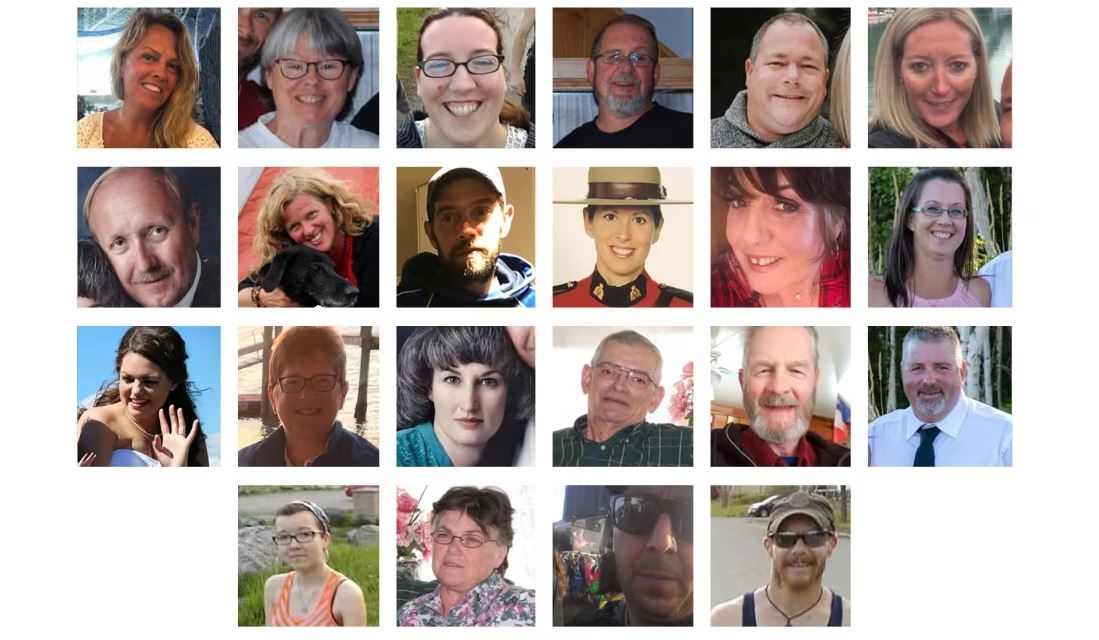
AB Post Exclusive Sunday Feature – In April 2020, in the first weeks of the Covid-19 pandemic, the most lethal mass shooting in Canadian civilian history unfolded over 13 terrible hours in Nova Scotia. A perpetrator shot and killed 22 people, one of whom was expecting a child. Many more people were harmed and affected, across Canada, the United States, and beyond.
As Canadians, were not used to such brutal violence although have grown accustomed to such events in our neighbours to the south where as of January 23rd of 2025, the United States has already experienced 15 mass shootings. They have reached a point where most such events don’t even make the news anymore as their citizens are numb to the carnage and killings.
But in Canada – when a mass shooter kills 22 people – it rocked the nation and triggered one of the country’s largest internal reviews and investigations ever undertaken. The result is the 7 volume report called the ” Mass Casualty Commission Report “. The massive document is 3000 plus pages, and was made public on December 3rd 2024.
Unfortunately most media outlets didn’t give the report much coverage, much of can be attributed to the size of the document and that news that happened almost 5 years ago is ancient history in today’s society.
In days it seems long since gone, the major news organizations would have devoted extensive resources to helping readers digest the report – but in todays age of sensationalism and front page coverage of Taylor Swift and Elon Musk – the news that actually matters to you and me as citizens of this country gets swept under the rug in the daily churn of the news cycle and click bait some might suggest is designed to distract us from the real news.
Immediately following the events of April 2020, the RCMP as well as Federal Government undertook one of the largest internal investigations of procedure and response in this Country’s history. A commission was formed under the banner of ” The Mass Casualty Report. ” The final result was a publication that spanned 7 volumes and over 3200 pages. It examines the events that happened that terrible day, how the RCMP responded both on the ground and from a command response, as well as the short comings of the operations of the department – and how to ensure that if something like this ever happens again, they will be better prepared.
The Mass Casualty Commission was the joint public inquiry created to examine the April 18-19, 2020 mass casualty in Nova Scotia and to provide meaningful recommendations to help make communities safer in the future. The three Commissioners that were jointly selected to conduct the inquiry are the Honourable J. Michael MacDonald, Leanne J. Fitch (Ret. Police Chief, M.O.M.) and Dr. Kim Stanton.
With the release of the final report, the Commission has finished its work and will no longer be responding to inquiries. For a full account of the Commission’s work, refer to the final report, timeline tool, Commissioned Reports, Foundational Documents and source materials found on this website.
Posted from the Commissions website on December 3rd, 2024.
What they left somewhat unaddressed is the rumors that the shooter was a possible informant tied to the RCMP and all the warnings they had that he was clean off his rocker.
How the Nova Scotia shooting unfolded
Police first responded to the shooting around 10 p.m. local time on 18 April, 2020 at a quiet cul-de-sac in the small, seaside community of Portapique. The gunman, Gabriel Wortman, first attacked his partner, Lisa Banfield, who managed to escape. Wortman was known to local RCMP as well as many residents of the community for his temper and accusations of domestic violence against Banfield.
The unobtrusive denturist would go on to kill in the first day of his rampage, 13 people while burning down several houses, including his own. Wortman, who was driving a replica of an RCMP cruiser and dressed in a fake RCMP uniform, managed to elude police overnight – and by the time he was killed in a shoot out with the police, he had killed nine more people, including a pregnant woman and an RCMP officer.

Wortman’s killing spree ended when he was fatally shot by two RCMP officers at a gas station located more than 90km south of where the shooting began. In the gun battle, Cst. Heidi Stevenson with the RCMP died during a confrontation with the killer.
The story kept not just Canadians glued to their televisions for two days straight – but also captivated the world where Canada is known as a peaceful nation where gun violence is a rarity – or at least in comparison to the United States.
Criticism of the RCMP Response and Culture
In the aftermath of the events that took place in Nova Scotia, the RCMP came under heavy scrutiny and criticism – much of which was levied by the force’s own members who testified about the lack of support from upper leadership.
“The RCMP as an organization wants to give this impression they care about their members…. Commissioner Brenda Lucki has said herself, ‘We’ll do whatever we can. We can’t do enough.’ The way we were treated after this is disgusting, absolutely disgusting — it’s why I left the RCMP,” Emergency Response Team leader Cpl. Tim Mills
The criticism began almost immediately in the aftermath of the shootings when it was learned that the shooter was well known to mounties. In the final report, Michael MacDonald, chair of the Mass Casualty Commission charged with overseeing the independent inquiry into the shooting, stated that “Many red flags about [the gunman’s] violent and illegal behaviour were known by a broad range of people, and have been brought to the attention of police and others over a number of years.” It harshly chastises the RCMP for failing to address the previous behaviour of the gunman, who was revealed to have been abusing his long-term partner for years and was known well by the local Mounties. This point ties back into the accusations that the shooter was either an informant or agent for the police at the time of the events.

Further criticism was heaped on the RCMP response for their lack of preparation to the event itself. The report called out the RCMP for their lack of preparedness for such a mass-casualty event as well as their initial response to the shooting – and the subsequent communication with the public during and after the shooting.
The report has noted that police in the initial hours of the attack discounted eyewitnesses who said the gunman was posing as an RCMP officer – a fact that was only finally communicated to the public more than 12 hours after the shooting began – and that the RCMP “seriously understated the threat” presented by Wortman to the public.
What the inquiry into the shooting heard
Listen to the Podcast Summary of the RCMP’s Findings in this Podcast feature below
[player id=’15470′]
Over the course of the inquiry, interviewers heard from more than 200 witnesses between February and September 2022, which included police officers, survivors as well as the families of victims.
Testimonies revealed that the RCMP were told that shooter was driving a ” fake police car ” during the initial 911 calls that came in first just after 10 pm. Despite the warnings, police took to 10 am the next morning to alert the public about the replica cruiser via Twitter.
In the report, families testified that some of the victims said the fake police car would have caught their loved ones unaware.
To further complicate the first nights events – the initial scene of the rampage was described as a “warzone” by the officers first on the scene, who said they were unsure how or what they were heading into as they navigated pitch-dark woods and chased the sound of gunfire.
The officers said they were out in the heavily forested woods and alone for more than 90 minutes, as the command center was unable to track them on site with GPS or communicate with each other – and there was concern police could accidently shoot each other.
In that time, the gunman Wortman managed to escape the scene the first night using a private dirt track with access to a nearby highway – all while RCMP helicopters remained unavailable due to mechanical problems.
RCMP Volume Index – The Mass Casualty Commission Final Report
| Volume Title | Page Count | Download Link |
|---|---|---|
| Executive Summary | 317 | Download Here |
| Volume 1: The Event & Response | 206 | Download Here |
| Volume 2: Victim Support & Impact | 379 | Download Here |
| Volume 3: Police Protocols & Procedures | 517 | Download Here |
| Volume 4: Recommendations for Change | 734 | Download Here |
| Volume 5: Public Communication & Media | 722 | Download Here |
| Volume 6: Organizational Review | 83 | Download Here |
| Volume 7: Appendices & Supplementary Materials | 294 | Download Here |
All PDF content is from the RCMP’s Mass Casualty Commission website located here.
In that time, the gunman Wortman managed to escape the scene the first night using a private dirt track with access to a nearby highway – all while RCMP helicopters remained unavailable due to mechanical problems.
RCMP Tactical Team Leader Speaks Out in Harsh Criticism of Command Chain
In April 2020, the area tactical team – or Emergency Response Team ( ERT ) that responded to the attack was made up of five full-time members as well as eight part-time officers who assisted with high-risk situations across the province. The unit was called in during barricaded people and calls that involved weapons. After being alerted at 10:45 pm that an active shooter was in the community of Portapique, Mills alerted his unit which assembled at the RCMP’s Dartmouth headquarters where they rushed to Colchester County.
The inquiry determined they arrived at the scene between 12:35 a.m. and 1:15 a.m where ERT took over the lead on the ground from the RCMP constables who were first on the scene and were in pursuit of the shooter.
The tactical team spent the next several hours following up on possible sightings of the gunman all while clearing and securing properties between 1:20 a.m. and 4 a.m. west of the subdivision where the suspect had already killed 13 neighbours.
Complicating the pursuit of the killer – during the overnight chase of it was revealed that the RCMP were communicating on an unencrypted radio channel, meaning that anyone with a scanner could have tuned in to hear the transmissions between the officers on the ground, the commander center as well as the dispatch centre.
No ability to track locations on phones
During those overnight hours, the tactical team and constables on the ground had to rely on verbal instructions from dispatchers to explain directions and keep each up to date on the situation. On the night of the shootings, the RCMP or tactical team didn’t have access to any air support as the only helicopter for the Atlantic region was down for maintenance, something that investigators heard wasn’t unusual.
The inquiry subsequently found the Department of National Defence mysteriously declined to provide one of their helicopters for the active shooter situation – and a provincial unit wouldn’t be able to arrive to assist until dawn.
Further complicating the situation was that the officers on the ground had been waiting for device upgrades as well as the app used to track each other has expired and not been renewed. Ottawa had been notified six weeks earlier of the need for the app’s subscription fee to be renewed.
Investigators said listening back to recorded communications of the first night’s events illustrates the “total confusion” that resulted in attempts to convey locations or details of the pursuit verbally.
“It was totally pitch black that night, poorly marked roads, rural area, trying to figure out where to go that night without that ability was frustrating and tough to do,” the commanding officer of the tactical team told the enquiry.
At day break, the provincial Lands and Forestry helicopter finally was dispatched and ERT moved ahead with plans to start evacuating homes. As the search intensified around the area, RCMP scoured for any potential ambushes in the “hot zone” around the shooter’s last known location citing concerns he was hiding in the woods around the area.
It was during this time that a new 911 call came in reporting another shooting about 40 kilometres away in Wentworth, N.S.
By the time a dog handler and a tactical officer shot and killed Gabriel Wortman at a gas station in Enfield, N.S., 22 people, including a pregnant woman, a teenager and an RCMP officer, had been murdered. Others were injured and several homes destroyed by fire in the 13-hour rampage.
Questions Raised as to the Shooters Relation with RCMP
One of the troubling aspects of this story is the suggestion that the gunman was associated with the RCMP. This accusation stems from the withdrawal of $475,000 in cash before the shooting spree that experts say matches the method the RCMP uses to send money to confidential informants and agents.
Sources in both banking and the RCMP say the transaction is consistent with operating procedure on how the RCMP funnels money to its confidential informants and agents, and typically is not available to private banking customers.
The RCMP has repeatedly denied that Wortman was an agent or informant – and that it had “ No special relationship with the RCMP whatsoever.” The investigation determined that there was not any relationship between the gunman and the RCMP outside of a reported estranged family relationship and two retired RCMP members.
RCMP do admit though that they don’t have an answer to Wortman’s large cash withdrawal, which was confirmed to be hundreds of thousands of dollars – although some suggested that the shooter believed that due to the worldwide pandemic, his money was at risk and was safer under his control. How he amassed such a cash reserve is still yet to be answered or why the bank was able to provide him with such a withdrawal.
Court documents show that the gunman owned a New Brunswick-registered company called Berkshire-Broman, and was the owner of two of his vehicles – one of which was the replica police car he used in the attack.
Authorities noted that there was no ” public evidence that it would have been able to move large quantities of cash.” Wortman did run his own denturist business but there was no reason to believe it would require him to handle large amounts of cash or make such a large withdrawal.
If Wortman was an RCMP agent – or some kind of informant – it could explain why the Mountie’s appeared not to take action on complaints about his illegal guns and his assault on his common-law wife.
RCMP can’t say what was done with the bulletin that was sent to police agencies in 2011
Police Knew in 2011 that Wortman was Armed and a Threat to the Public
It was in May of 2011 that RCMP received a tip that Gabriel Wortman was harboring a stash of weapons and had told others he wanted to ” kill a cop “. The 2011 warning came after an unnamed source provided detailed information about where Wortman kept his guns and was transporting weapons between his home and his cottage in Portapique, Nova Scotia. It appears that because Wortman lived in Dartmouth, but his cottage was in another district, the tip may have got lost in the bureaucracy of the two detachments and there is no files that show any follow up took place – although the alert was passed on the Halifax police department who did follow up on the matter.
The tip also asserted that Wortman may also be in possession of several long rifles located at his cottage and were stored in a compartment located behind the flue of his fireplace.
The person that provide the tip told RCMP that Wortman was “under a lot of stress lately” and was starting to have some mental health issues, describing him as “becoming a little squirrelly.”
Bulletin purged from RCMP records
The Halifax Regional Police records show that they investigated the tip at the time and interviewed some of Wortman’s relatives. Police determined that any information about weapons was related to Wortman’s cottage and not his property in Dartmouth at which time they sent their findings to the associated RCMP detachment.
The bulletin only came to light three weeks after the shootings when an officer from the Amherst Police Service recalled Wortman’s name and was able to retrieve an email dated back to 2011. Up until this point, it appears RCMP had purged all mention of Wortman from their records in what they have stated is standard procedure.
It was then revealed that Wortman had also been investigated a year prior for uttering death threats to his parents in 2010 which also noted he owned a stock of guns. Halifax Regional Police investigated the claims, but closed the file without laying charges, citing there wasn’t enough evidence to lay charges or get search warrant.
Are Lesson’s Learned ?
The Nova Scotia mass shooting that took the lives of 22 people revealed critical failures within the RCMP’s preparedness and response. Despite prior warnings about the shooter’s violent history and a 2011 tip about his weapons, the RCMP in retrospect failed to take appropriate action, contributing to the tragedy – and could be argued that the entire event could have been avoided if they had taken the matter more seriously.
Poor communication, the use of unencrypted radio channels, and inadequate coordination between officers hindered the response by no fault of the responding officers. The case outlines how the the RCMP also lacked essential resources, such as air support and reliable tracking technology, further complicating their ability to manage the situation effectively.
The shooting’s aftermath has had a lasting impact on both the community and the country. This has been further complicated by the RCMP’s lack of transparency and failure to address prior warnings raised questions about their accountability. Hopefully though the 22 people that lost their lives will have not died in vane and the authorities have learned their lesson.
We can only hope.
To read the RCMP’s Final Report in it’s entirety, visit their website here.


